Injection Molding and Extrusion Screw Coatings: Common Coatings and How to Choose
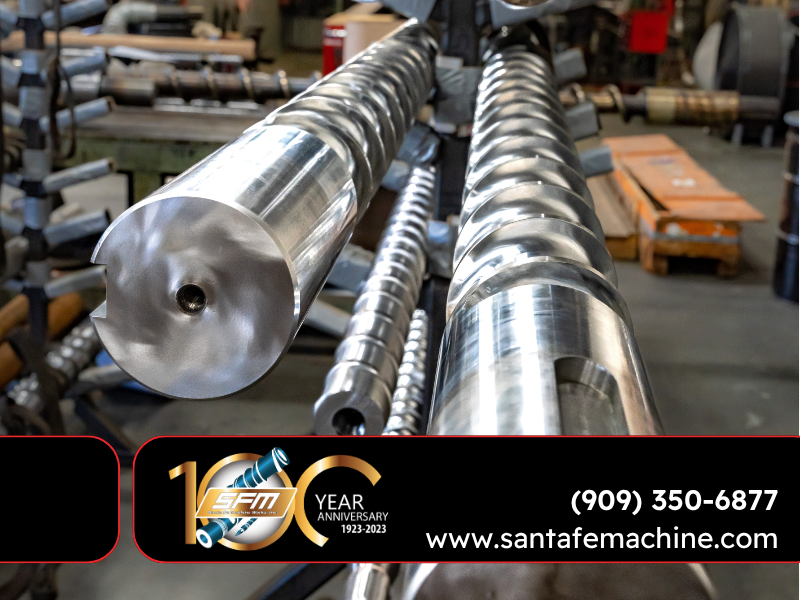
Screw coatings for plastic injection molding and extrusion are engineered protective surface layers applied to the screws to improve wear life and stabilize melt performance. They are selected to address the most costly problems in a specific operation, including abrasive wear from filled formulations, sticking and drag that disrupts melt delivery, erosion that accelerates channel and flight damage under high shear, and corrosion that roughens surfaces and can contribute to streaks or melt-quality instability. Since each formulation and process has different stressors, the correct coating is the one whose performance mechanism matches the customer’s dominant failure mode while remaining compatible with the machine’s thermal profile and the customer’s maintenance practices.
The most practical way to choose a screw coating is to start with symptoms and operating context, not coating names. For example:
- If you see progressive wear at specific screw regions, rising torque over time, or loss of screw geometry that correlates with degrading output or surface finish, abrasive or erosive wear is usually the driver and selection should prioritize hardness, abrasion resistance, and coating adhesion.
- If the symptoms are inconsistent melt delivery, increased drag, or material buildup that clears only through aggressive cleaning, the coating choice should focus on reducing polymer-to-metal adhesion and maintaining a surface condition that supports stable plasticizing.
- If corrosion is present, the recommendation must include chemical resistance considerations, because a coating that survives melt contact may still fail prematurely due to frequent cleanouts or cleaning chemistries.
Coating selection should also be grounded in process reality. Even with correct barrel temperature control, local screw surface temperatures can rise due to shear heating, frictional contact, and transient operating conditions such as overloads, bridging events, or starts and shutdowns. A coating that performs under steady conditions can degrade during thermal cycling if it cannot withstand the thermal stresses and oxidation behavior encountered in production. Similarly, cleaning practices matter: frequent chemical purges or harsh cleanouts can be as important as the melt itself when evaluating coating durability.
For filled or abrasive formulations, filler type and loading strongly influence coating aggressiveness requirements. Higher filler levels, particularly glass fiber and mineral systems, tend to increase wear potential and demand coatings that resist abrasion without sacrificing adhesion and toughness. A coating that is extremely hard but prone to microcracking or spalling can create new problems, including contamination and surface-quality issues. At the same time, coatings must preserve the screw’s functional melt-delivery and mixing behavior, because changes in surface conditions can affect frictional characteristics, melt flow behavior, and process stability. The blog takeaway is simple: coating selection is engineering matching, not a one-size-fits-all upgrade.
A good way to select a screw coating is to start with the dominant mechanism you need to control in your specific molding or extrusion operation, then match that requirement to coating technology while checking thermal and chemical compatibility.
| Most common screw coating families used in polymer screw/barrel protection | What they are typically chosen to do | Selection emphasis |
| Hard, abrasion-resistant / hardfacing-style surfaces (varies by supplier and metallurgy approach) | Reduce abrasive and erosive wear, slow loss of channel and flight geometry | Confirm wear location, filler type and loading, and thermal cycling behavior; prioritize adhesion and resistance to microcracking or spallation |
| Carbide-enhanced surfaces | Provide very high abrasion resistance and durability in filled or abrasive compounds | Validate toughness and coating integrity under shear and impact; ensure the coating does not create unacceptable roughness or surface-quality risk |
| Nitriding and diffusion-related hard layers (where applicable) | Increase surface hardness and wear resistance with strong metallurgical compatibility to the substrate | Confirm temperature exposure compatibility and expected wear mode; align with screw metallurgy and process thermal envelope |
| Hard chrome and related hard-plated surfaces | Improve wear resistance and surface stability in demanding cycles | Check coating uniformity expectations for your screw geometry; confirm chemical exposure and cleanout compatibility |
| Thin-film physical vapor deposition (PVD) families (e.g., nitrides and multi-layer variants) | Improve wear resistance with a combination of hardness, friction control, and oxidation stability | Confirm the coating survives polymer processing thermal loads and shear contact; verify adhesion and resistance to flaking under your cycling and cleaning conditions |
| DLC-type carbon-based thin films (application dependent) | Reduce friction and help mitigate sticking and drag-related problems | Validate that the film survives your temperature, particulate environment, and cleanout chemicals without losing integrity |
| Corrosion-resistant surface protection coatings (technology dependent) | Resist chemical attack that leads to pitting, roughening, and fast deterioration | Tie selection directly to resin chemistry and cleanout chemicals; confirm compatibility with shutdown and cleaning regimen |
Basically, coating selection is engineering matching, not a one-size-fits-all upgrade.
How can we help you?
Santa Fe Machine Works, Inc. has been in continuous operation since 1923. For more than 45 years, we have focused exclusively on the design, manufacture, and rebuilding of injection and extrusion screws, barrels, and valves for the plastics industry. This specialization enables the development of custom-engineered screw, barrel, and valve combinations that are precisely matched to material behavior, processing conditions, and production objectives. Each solution is built to improve throughput stability, extend component life, and reduce unplanned downtime across both injection molding and extrusion operations. Our team brings more than 200 years of combined experience in plastics processing, metallurgy, and the design of wear-resistant components. That depth of expertise supports practical, application-specific recommendations for demanding production environments. For technical questions, application support, or quotation requests, contact Santa Fe Machine Works, Inc. to discuss your injection or extrusion requirements.