Engineering Realities Defining Plastic Extrusion Manufacturing in 2026
This year, plastic extrusion manufacturing has been increasingly governed by the physics of continuous flow rather than discrete production events. For engineering teams, performance is measured by sustained dimensional control, thermal equilibrium, and mechanical consistency across extended run times. The dominant challenges in extrusion are not isolated disruptions but cumulative effects that emerge gradually and demand proactive technical management.
Continuous Flow Stability and Melt Behavior
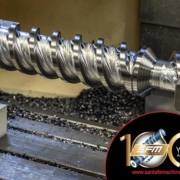
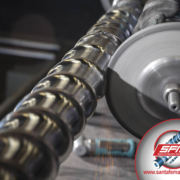
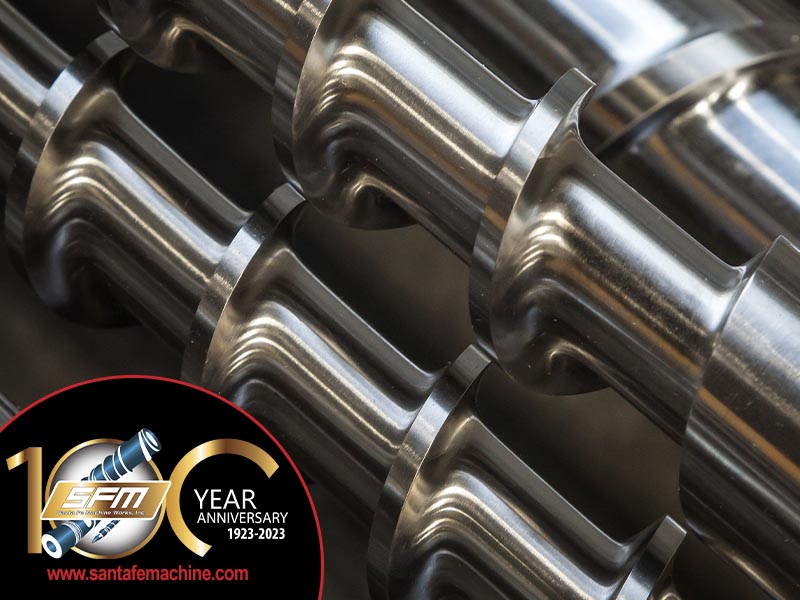
Extrusion processes amplify small disturbances over time. Minor fluctuations in melt temperature, shear rate, or polymer viscosity can evolve into measurable dimensional drift, surface variation, or output instability after hours of operation. Engineers must manage melt homogeneity at the screw level, balancing distributive and dispersive mixing without introducing excessive shear. Long residence times place additional constraints on temperature profiles, particularly for heat-sensitive materials and recycled blends. Unlike cycle-based manufacturing, extrusion offers limited opportunities for correction once instability is established, increasing the importance of conservative process windows and early detection.
Die Performance and Thermal Uniformity
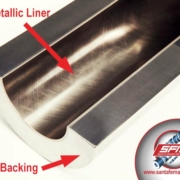
In 2026, extrusion die performance will remain one of the most critical and least forgiving aspects of the process. Flow imbalance, localized temperature gradients, and gradual die wear directly affect profile geometry and surface quality. Engineering teams are increasingly focused on maintaining thermal symmetry across die zones and preventing stagnation areas that promote polymer degradation. Advanced die materials and coatings extend service life, but they also require tighter startup and shutdown discipline to avoid premature damage. Die tuning is no longer treated as an operator-level adjustment. It is an engineering-controlled activity driven by flow modeling, thermal mapping, and dimensional feedback from inline measurement systems.
Startup Losses and Line Recovery Dynamics
Material and energy losses during startups and transitions will account for a disproportionate share of extrusion costs throughout 2026. Line recovery time following die changes, screen pack replacement, or unplanned stops directly affects profitability and delivery reliability. Engineers are required to design startup procedures that minimize thermal overshoot, pressure spikes, and off-spec output. Screw design, barrel zoning, and downstream synchronization all influence how quickly steady-state conditions can be reestablished. This focus shifts attention away from nominal line speed and toward repeatable recovery performance under non-ideal conditions.
Recycled Material Behavior in Continuous Processing
Extrusion is often the first manufacturing process to absorb increased recycled content targets, introducing cumulative rather than immediate variability. Contaminants, residual moisture, and volatile compounds may not manifest as defects until after prolonged exposure to elevated temperature and shear. Engineering controls increasingly include enhanced filtration, degassing zones, and conservative residence time limits to manage these risks. Material qualification must account for extended production scenarios rather than short validation trials. This reality places greater responsibility on engineers to define acceptable variability and to design processes that degrade gracefully rather than fail abruptly.
Instrumentation, Trend Analysis, and Process Discipline
Extrusion operations this year will generate continuous streams of process data, but the challenge lies in interpreting rather than collecting them. Torque drift, pressure trend changes, and energy consumption patterns often provide earlier indicators of instability than dimensional measurements. Engineers must establish meaningful trend thresholds and avoid overcorrection, which can introduce additional variability. Effective process discipline emphasizes controlled response and long-term stability over short-term optimization. Integration of extrusion data into plant-wide systems has increased visibility, but it has also elevated expectations for engineering accountability and root-cause analysis.
Sustained Precision as a Competitive Requirement
Precision in extrusion manufacturing is defined by consistency over time. Customers increasingly evaluate output quality across the entire production run, including startup material and tail-end performance. This expectation elevates the importance of cooling and calibration system stability, wear management, and preventive maintenance planning. Engineering teams are tasked with maintaining predictable performance even as material inputs and demand patterns fluctuate.
Plastic extrusion manufacturing this year will demand an engineering mindset centered on continuous stability, thermal balance, and cumulative process behavior. Success will be determined less by peak capability and more by the ability to maintain controlled conditions over time. Organizations that prioritize disciplined process design, early trend detection, and engineered recovery strategies will be positioned to meet tightening quality and cost expectations in an increasingly complex extrusion environment.
How can we help you?
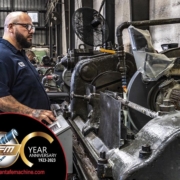
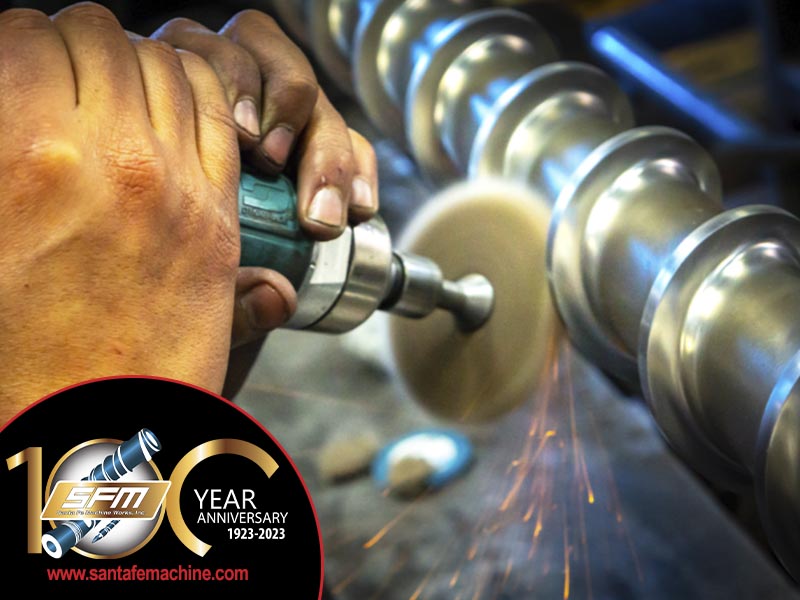
Santa Fe Machine Works, Inc. has been in continuous operation since 1923. For more than 35 years, we have focused exclusively on the design, manufacture, and rebuilding of injection and extrusion screws, barrels, and valves for the plastics industry. This specialization enables the development of custom-engineered screw, barrel, and valve combinations that are precisely matched to material behavior, processing conditions, and production objectives. Each solution is built to improve throughput stability, extend component life, and reduce unplanned downtime across both injection molding and extrusion operations. Our team brings more than 200 years of combined experience in plastics processing, metallurgy, and the design of wear-resistant components. That depth of expertise supports practical, application-specific recommendations for demanding production environments. For technical questions, application support, or quotation requests, contact Santa Fe Machine Works, Inc. to discuss your injection or extrusion requirements.